What this compares
A sponge carries no ingredient list. No INCI panel, no CAS number, no SmartLabel page, because a sponge is an article rather than a formulation, and articles sit outside most of the rules that force a bottle of detergent to declare itself. A sponge brand therefore tells you what its sponge is made of only if it wants to. Most of this shelf does not want to.
We took six scrub sponges and read each on the same six criteria this site uses everywhere, with the rows that normally ask about a formula read on materials instead. No sponge carries a dissolving film, so the polyvinyl alcohol row is read on material shedding: plant fibre throughout takes the top band, a named synthetic with nothing said about shedding takes the bottom one, and a page that names no material at all takes the bottom one as well, because silence cannot be checked. The ingredients-of-concern row reads each published material list against the site’s watch list, so a sponge that names a polymer is judged on what it named. The order is ours, chosen on those readings, and nothing in it turns on how well anything scrubs. We have not washed a plate.
What we found
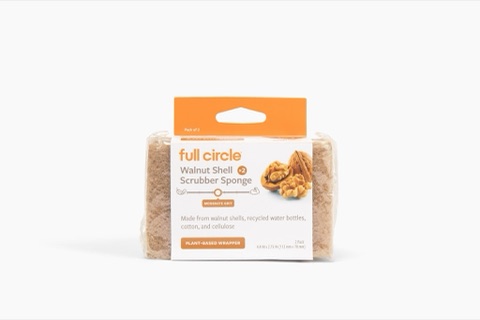
The pattern here runs backwards from the detergent pages. On those, the mainstream brands published complete ingredient lists and the lower-tox brands wrote around them. In sponges it is the naturals who spell it out and the incumbents who say nothing. Full Circle prints recycled plastic in the stated composition of its own signature walnut sponge[3]. Marley’s Monsters names the polyester mesh on the scrubbing face of the sponge it sells as the reusable answer to disposables[5]. Scrub Daddy names a trademark and stops[6]. 3M gives the whole composition of a Scotch-Brite sponge in a single line[7]. The brands with the most to answer for are the ones with nothing to declare.
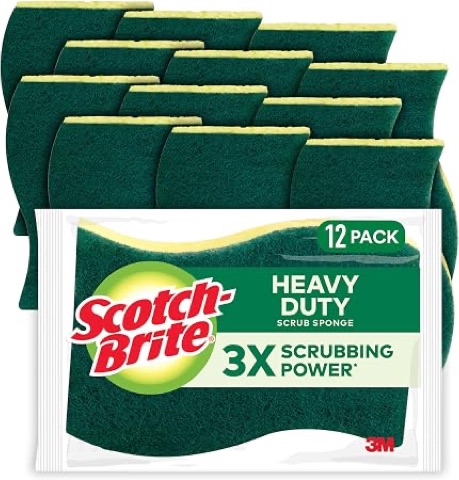
That 3M line is the flattest disclosure we have read on this site. The Article Information Sheet for the Heavy Duty Scrub Sponge, document group 43-9133-0, version 2.00, issued 13/05/2025, gives section 3 as one row: ingredient Heavy Duty Scrub Sponge Mixture, no CAS number, 100 per cent by weight[7]. 3M declines to prepare a safety data sheet at all, on the grounds that the product is an article and therefore exempt from hazard communication requirements. That position is legally correct. It is also why the most widely stocked scrub sponge in the country publishes less about its own materials than any lower-tox brand in this table. Scotch-Brite then takes no card for a duller reason on top of that: scotch-brite.com and 3m.com refused or timed out on every fetch from this session, so no price and no pack count could be read[8].
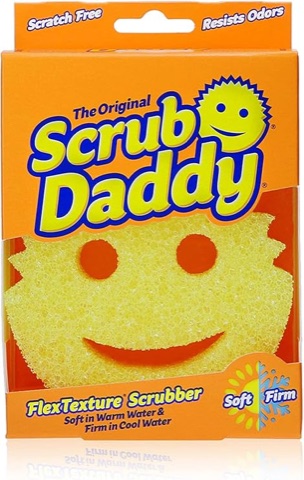
Scrub Daddy is the same silence with better marketing. The product page names FlexTexture and leaves it there[6]. No polymer, no resin type, no recycled content, no end-of-life route, and no plastic-free or microplastic-free claim either, so there is nothing on the page to hold it to and nothing on the page to check. Retail listings elsewhere call FlexTexture a polymer foam. That is not a first-party statement and it settles nothing, so it stays out of the table. What the table records is the disclosure, and the disclosure is a trademark. Ingredient transparency lands in the lowest band there is.
Full Circle sells both sides of this argument on the same website. The loofah sponge gives the construction in a line, natural loofah, plant-based cellulose and cotton stitching, and claims to be 100% microplastic-free[2]. The walnut sponge, the one with the brand’s own pun on the label, opens with plant-based beauty and then gives the composition as walnut shells, cellulose, and recycled plastic[3]. Both statements were live on 14/08/2026, and each is accurate on its own page. Read across the range, the loofah sponge is the plastic-free product and the walnut sponge is the product people buy believing it is.
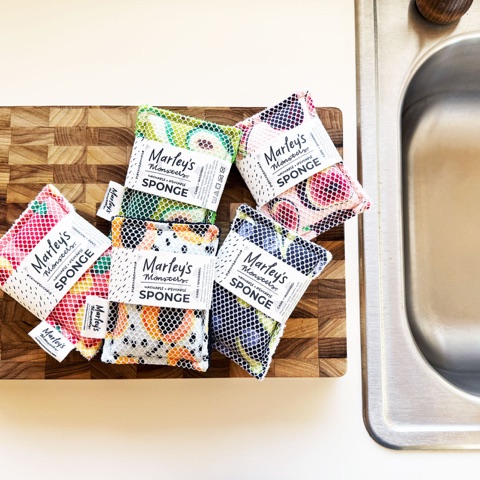
Marley’s Monsters is the most interesting entry here and the hardest to place. The washable sponge is not a disposable at all: cotton terry on one face, cotton flannel with a polyester mesh layer on the other, a fill of recycled foam, machine and dishwasher washable, sold as the thing you buy instead of a bag of sponges[5]. It makes no plastic-free claim, which is exactly why the polyester costs it nothing on transparency and everything on the material row. Polyester mesh in a washing machine sheds. The page does not raise the subject, and the polymer in the foam fill is never named. At $14.00 for a single sponge it is 6.2 times the cheapest unit here, which may well be fair for something you keep for years. Nobody has published how many years that is.
Cost per sponge is the weakest column on this page, and we would rather say so than dress it up. A walnut pad at $2.25 and a washable sponge at $14.00 are not the same purchase: the first is meant to be binned, the second is meant to go through the wash. The column records what a brand charges for a unit, not what a year of clean dishes costs, and no page in this category publishes a lifespan you could use to work out the second figure. Vove claims three times the life of a plastic sponge and publishes nothing at all behind the number[1].
Nothing in this table is a melamine eraser, which is worth explaining, because melamine is where the measured evidence in this category actually sits. A melamine block works by abrading itself, so the worn material is the mechanism rather than a defect. A 2024 study in Environmental Science and Technology identified what comes off as poly(melamine-formaldehyde) microplastic fibre and put the release at roughly 6.5 million fibres per gram of worn sponge[9]. Ordinary plastic sponges shed more slowly: a 2026 paper in Environmental Advances estimates kitchen sponge use at 0.68 to 4.21 grams of microplastic per person per year[10]. For context and nothing beyond context, plastic particles have been measured in human blood, in 77 per cent of the samples in a 2022 study[11]. That is a detection finding rather than evidence of harm, and no sponge on this page protects anybody from anything. It is one plastic input in a kitchen that happens to be an easy one to take out.
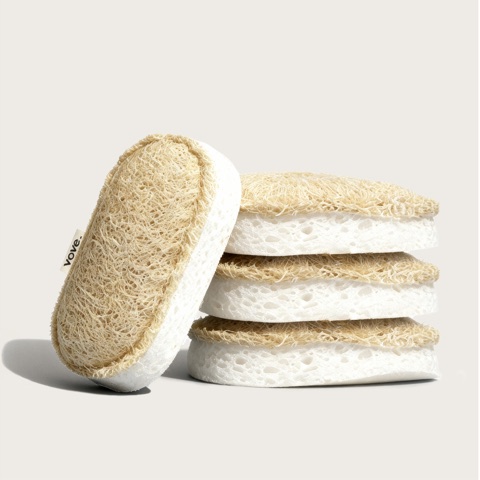
Materials are now read against a published watch list as well as counted, and in this category the list is what separates plant fibre from foam. Nothing here trips the upper tier. What the lower tier catches is the same admission four times over: Full Circle’s walnut pad and the Scotch-Brite sponge both give their scrubbing face as recycled plastic without naming the polymer[3][7], Scrub Daddy’s FlexTexture is a polymer foam and nothing more precise[6], and the Marley’s Monsters sponge carries a polyester mesh and a foam fill whose polymer is never named[5]. Vove’s sponge and the Full Circle loofah come back with nothing on the list against them, loofah, cellulose and cotton in one case and loofah, cellulose and cotton stitching in the other[1][2]. The new row does not change our order. It widens the gap between the plant-fibre pair and the rest, and it puts a name on why.
Which brings us to the awkward part. Our own sponge holds the top card here, and it holds it largely because it is the only product in this table that could be read on every criterion. Every other sponge here has at least one cell nobody published. Full Circle’s loofah sponge reads better than anything else on the page on the criteria it can be read on, and it takes no card because its listing never says how many sponges you get. Placing a product on the rows it did fill in only flatters whichever brand published least, so a product with a blank cell keeps its facts and takes no position. That rule is not bent for the brand that owns the site.
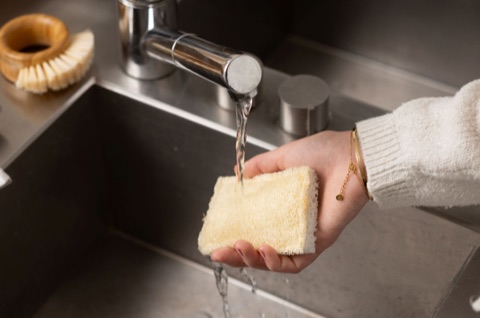
What the transparency row shows for Vove is a full material list on the product page: loofah, cellulose and cotton, each fibre named with the job it does written beside it, which is the top band[1]. That is the row the rest of this shelf falls down on, and it is a large part of why our own sponge holds the top card. The packaging row carries a warning of its own: Vove takes it because it is the only page in the category that mentions packaging at all, and what it mentions is a certification rather than a material, so the top packaging band here rests on a logo instead of a described material.