What this compares
A dish brush is the cheapest thing in a low-tox kitchen and among the easiest to get wrong. Wood and pale bristles photograph as plant fibre, and the material doing the scrubbing is often not the material in the photograph. Bristles are the part that wears down. They are also the part that leaves the brush and goes down the drain with the food.
We took four brushes, three of them sold as the better choice, and read each against the same columns as the rest of the site, adapted where hardware demands it. Ingredient transparency becomes the materials list, and the ingredients-of-concern row reads that list against the site’s watch list. The polyvinyl alcohol row becomes the bristle row, because no brush puts a film in your water, and a plastic bristle sheds as it scrubs. The refill column means a body you keep plus plastic-free replacement parts, rather than a tin and a paper sachet. Nothing here turns on how well anything scrubs, because we have not washed a plate.
Cost per use is the awkward criterion in a category of durables. No brand publishes how many washes a brush survives, so a cost per wash would be a number we made up. What every page does publish is how many bristle heads the price buys, and that is what the cost row measures: price divided by heads in the box. A one-piece brush counts as a single head, because when its bristles splay the handle goes in the bin with them. Read that row as the price of a fresh scrubbing surface, then read the price row above it for what the shelf charges today.
What we found
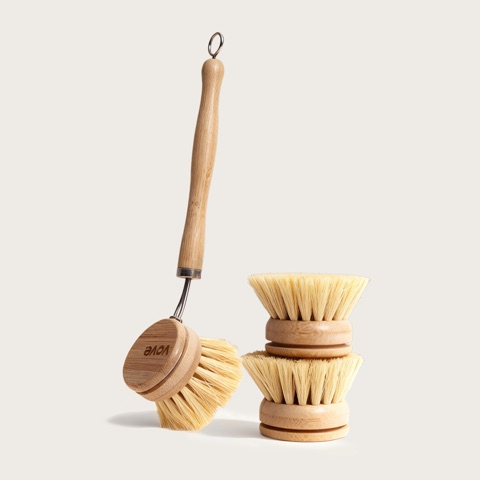
Vove’s set is our choice in this category, and Vove owns this site, so the case for it is printed in full and you can weigh it yourself. The product page names every material in the brush, bamboo, sisal, stainless steel and the kraft box it ships in, and gives each one a job[1]. The bristles are plant fibre, so the part that wears down is not plastic. The handle stays and the heads are swapped, and the heads are sold on their own, which is what we want from a refill. The head is also the cheapest here at $6.00, with no products in the table costing less.
The cost row takes a caveat rather than applause. Vove comes out cheapest a head because $18.00 buys a handle and three heads at once, not because a sisal head has been shown to outlast a nylon one. Vove is the only brand here that publishes a working life at all, two to three months a head[1], and a figure from the company selling the heads is a claim and nothing more. At the till the Full Circle brush is $7.99 and the Vove set is $18.00, the dearest thing on this page, and the till is the row a shopper meets first.
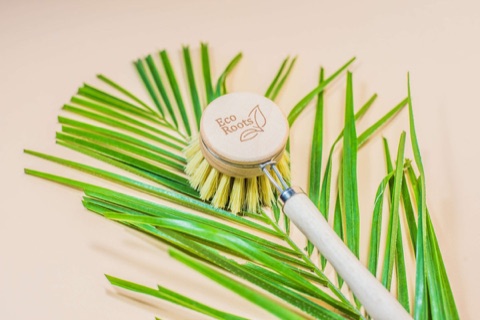
We put EcoRoots next, and it is the brush to buy if you would rather not buy from the company behind this site. German beech handle, sisal bristles, a head that detaches, sold package free, and an end-of-life claim broken down by part: the wooden head and the sisal compost, the metal staples go in the metal recycling[2]. What keeps it behind our own set is the cost of a head and the absence of any third-party mark, and nothing else. $11.00 buys a single head, which puts a head at $11.00 against $6.00, and the one after that is $7.99[2]. The brand carries no third-party mark at all. It is also a small brand beside the incumbent under it, and where a small brand publishes as much as a large one we give the smaller the benefit of the doubt. That is our stance rather than a neutral rule, and it is stated here so you can discount it if you disagree.
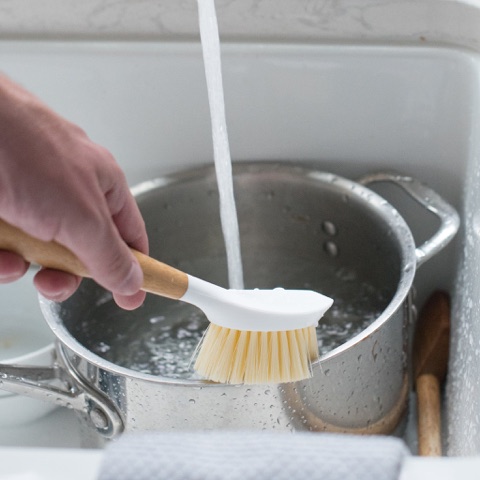
Full Circle is the one to look at twice. Its Daily Dish Brush photographs as the natural option, bamboo handle, pale bristles, and the bristles are recycled plastic. The page says so, in the Design block, in those words, and describes the plastic as phthalate free[3]. So the plastic is not tucked away, and the bristle row records a named synthetic rather than silence. What the page does not do is name the polymer or say anything about what a plastic bristle sheds as it wears, and the finish on the bamboo is given as a non toxic coating with nothing behind the phrase. At $7.99 it is the cheapest brush in the table, and it is not a plant-fibre brush.
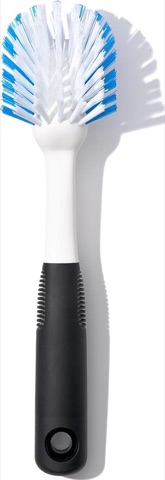
OXO is the incumbent and the brush most kitchens already own. Its page names nylon bristles and stops: no material for the handle, nothing about the pack, nothing on shedding[4]. It is $9.99, and on 14/08/2026 it was listed out of stock on OXO’s own site, with the in-stock substitute a soap-dispensing brush at $13.99[4]. It publishes less than anything else here, and that is why we put it at the bottom of the order.
Both plastic-bristle brushes sit at the bottom of the order, and for the same reason. Neither page describes what the brush comes wrapped in. Packaging is among the things this page reads, and a brand that says nothing there gets no credit for the silence, so we will not put either brush above one that named its box, and neither takes a verdict. We hold Vove to that on the same terms, and on this page it happens to cost the two rivals. In detergent the row brands skip is the ingredient list. In hardware it is the box.
Both plant-fibre brushes stretch the compost claim, and they stretch it the same way. EcoRoots puts sustainable and compostable in its bullet list and qualifies it a paragraph later, head and bristles composted, staples recycled[2]. Vove ticks compostable at end of life in a comparison block, and the qualification sits elsewhere on the same page, where the materials list gives stainless steel as recyclable and the sustainability text limits biodegradability to the natural parts[1]. Neither loses ground with us for it, because on both pages the breakdown by part is there to read. Vove’s is the weaker version: a tick has nowhere to put a qualifier, and neither of these brushes is all plant.
The materials list is now read twice: once for whether a page publishes it, and once for what it contains. Nothing in this category reaches the upper tier of the watch list. Full Circle takes a lower-tier flag for bristles given as recycled plastic with no polymer named[3], and OXO takes one for nylon, a shedding synthetic[4]. Vove and EcoRoots come back with nothing from either tier: bamboo, sisal, stainless steel and kraft in one case, beech, sisal and metal staples in the other[1][2]. That row counts for a great deal with us, and here it lines up exactly with the order the page already had, so it widened the gap at the top rather than moving anybody.
What nobody publishes is the thing this category argues about. No brand here publishes a shedding figure for a nylon or recycled-plastic bristle, and the published work we could find looks at sponges rather than dish brushes, so this page puts no number on it either. The bristle row records what the page says the bristles are made of, which is a question with an answer, and stops there. Anyone telling you how many particles a worn brush sheds into a sink is estimating from something else.
A brand that turns up in every bamboo roundup is missing from the table. Brush with Bamboo does not sell a dish brush. Its shop, read on 14/08/2026, runs to toothbrushes, oral care, hair brushes, neem wood utensils, straws and cotton produce bags, and the nearest thing to a kitchen brush is a pack of agave straw cleaners[5]. There is nothing to compare, so there is no column.