What this compares
A bottle brush is the dullest object in the sink. It is also the only cleaning tool you drag under friction around the inside of something you drink from. Most of them have nylon bristles, and nylon is plastic. A brush cleans by abrasion, which is the action that wears material off a surface. That is the whole of the low-tox argument for a natural-fibre brush, and it is worth checking rather than repeating.
We took three brushes and read each against the things a reader can check from a product page: whether the brush’s material make-up is published, what those materials are when the list is read against the site’s watch list, what the bristles are made of and whether the page says so, what a brush costs, what the pack is made of, and which third-party marks the product carries. Nothing here turns on how well a brush cleans, how long it holds its shape or whether it dries without going mouldy, because we have not scrubbed anything. In a category with no detergent in it the polyvinyl alcohol row becomes a question about bristles, and it is read that way. Plant fibre sheds no plastic and a plastic bristle does, so the row turns on whether the page tells you which one you are buying.
What we found
Vove is our choice in this category, and the choice wants qualifying before anybody quotes it. Vove is the only brush here whose page answers every column, because neither rival describes the packaging its brush arrives in[2][4]. A brand that leaves that blank gets no credit for the silence, so we will not put either rival above the brush that filled the page in, and neither can be named in a verdict. The same stance took the cheapest powder out of the laundry order. Here it applies to both rivals at once, which leaves a thin table at the top.
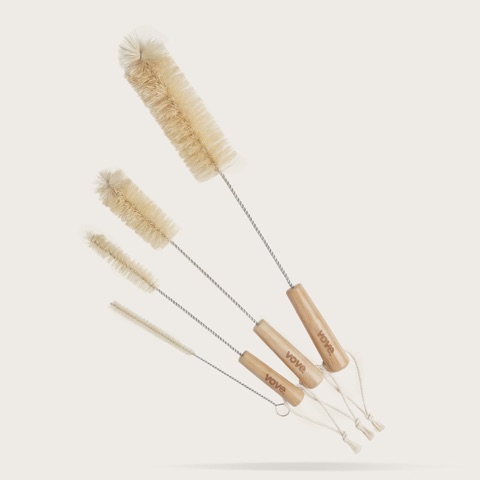
What the transparency row shows for Vove is a full component list on the product page: a bamboo handle, sisal bristles, a stainless steel core wire, a cotton hanging loop and kraft packaging, every part named with the material it is made of[1]. That is as much as any page here publishes, level with Full Circle and clear of OXO, which names its bristles and stops[2][4]. One thing on that page is still worth a reader’s attention: the comparison block ticks Replaceable heads and parts, the set is four one-piece brushes, and Full Circle is the brush here that sells a replacement head, at $9.98 for a pack of two[2][3].
The row under it ticks Compostable at end of life[1]. The component list on the same page names a stainless steel core wire that holds the bristles in place, so the wire has to come out before anything goes in a compost heap, and the page never says so. Bamboo, sisal and cotton will break down. A tick that covers the whole product is doing more work than the materials underneath it can support.
No brush in this table contains polyvinyl alcohol, so the signature row is read one material along. What Full Circle and OXO contain is nylon, a synthetic polymer sitting exactly where the film question usually sits, and both name it on the product page[2][4]. Naming it counts for something. A named synthetic reads better with us than silence, the same way a pod brand that declares its film does, and Vove reads best here because sisal and bamboo have no plastic bristle to wear away[1].
The material list is now read against the site’s watch list as well as counted for whether it exists. Nothing in this table reaches the upper tier. Full Circle takes lower-tier flags on two entries at once, nylon bristles and a second line giving recycled plastic with no polymer named[2], and OXO takes one on its nylon[4]. The Vove set comes back with nothing from either tier: bamboo, sisal, stainless steel, cotton rope and kraft, each named[1]. So the watch-list read and the materials disclosure point the same way, which is unusual, and it is the plainest reason the order came out as it did. The cost row and the certification row are where the argument still is.
What nobody has published is a number for a bottle brush. No study we could find has counted what one sheds, and we are not going to borrow somebody else’s experiment and pretend it measured this. The nearest measured work is a toothbrush: a 2025 paper in the Microchemical Journal measured microplastic release from commercial toothbrushes during simulated brushing[7]. Next nearest is a cleaning sponge, where abrading melamine sponges released 6.5 million microplastic fibres per gram of sponge worn away[8]. Neither is a bottle brush. Heat is the other half of the argument, and the clearest figure there describes the container rather than the tool: polypropylene infant feeding bottles released up to 16.2 million microplastic particles per litre when formula was prepared with hot water[9]. The mechanism is not in dispute. The dose off a brush is nobody’s published figure, so what this page reads is what the page discloses, not a quantity we would have to invent.
Vove is the dearest brush at the till and the cheapest per brush, and both are true for the same reason. $17.00 buys four brushes in graduating sizes, which is $4.25 each against the $7.49 a single Full Circle brush costs, 1.8 times as much per brush[1][2]. If you want one brush for one bottle, that per-brush figure is not your figure: either single brush costs $7.49 and the set costs $17.00. The cost row reads per brush because that is the only unit this category has, and on a set of four it flatters us. No products in the table cost less per brush, and both rivals cost less at the till.
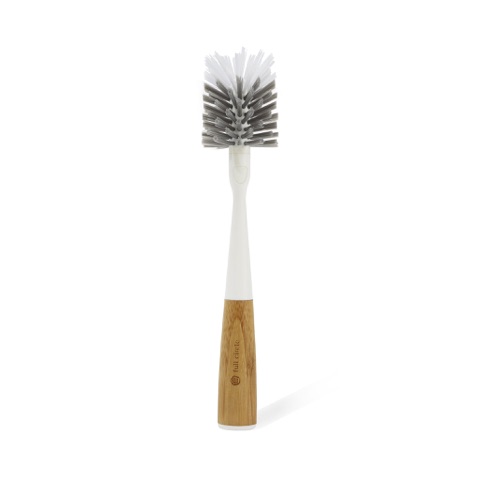
Full Circle publishes its materials in full and still does not take the page. Its page names nylon bristles, bamboo and recycled plastic in a single line, which is more than the incumbent manages and enough to match ours on the transparency row[2]. It also does the thing this page has no column for: the head comes off and a replacement pack costs $9.98[3], so the part that wears out is the part you buy again, and the bamboo handle stays in the kitchen. What the page never says is what the brush ships in, so the packaging cell stays empty, and we will not put it above a brush that filled that cell in. Two smaller things sit oddly on that page: the coating on the bamboo is called non-toxic without being named, and a brand paragraph in the middle of a nylon-bristled product describes Full Circle products as compostable[2].
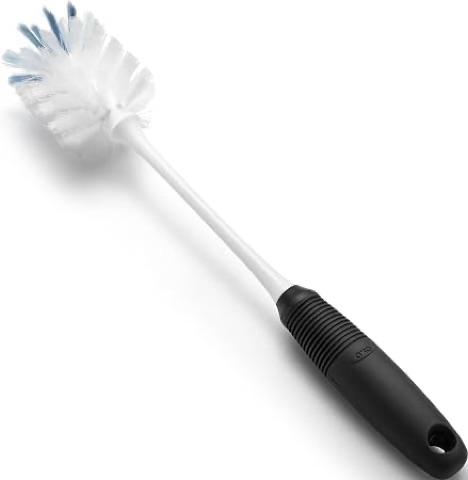
OXO is the incumbent and the least forthcoming. The product page describes dual-action nylon bristles, stiff and soft in one head, and says nothing about what the handle is made of[4]. That is not a material list, so transparency reads worst here even though the bristles are named, because the rows ask different questions: one asks what the bristles are, the other asks what the brush is. Packaging is not described either, so OXO sits at the bottom of our order. Worth recording for anyone repeating the check: oxo.com sits behind a bot wall that answers a plain fetch with a 403, so the page was read in a browser on 14/08/2026.
A brand that appears in most low-tox brush roundups is missing from the table. EcoRoots sells no bottle brush. Its Home and Kitchen collection carries a straw cleaning brush at $2.75, stainless steel handle and coconut fibre bristles, and that is the closest thing in the range[5][6]. A straw brush is not a bottle brush, so there is no column instead of a flattering stand-in.
The certification row is thin for everybody, which says more about the category than about the order. Vove lists a single mark, FSC, and it covers the bamboo and the carton rather than anything about how the brush performs or what comes off it[1]. Neither rival lists a mark at all[2][4]. There is no product standard anywhere in this table of the sort the detergent aisles are full of, and a single mark on a carton is not something worth putting on a box.